An undergraduate student from our college has published a high-level paper as the first author in a Chinese Academy of Sciences TOP journal.
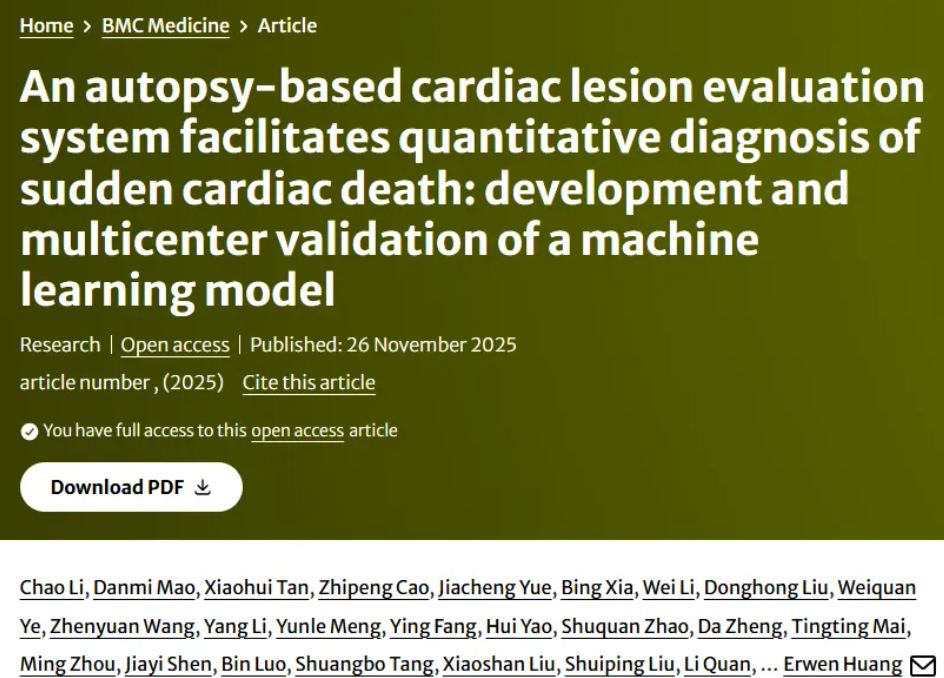
Recently, Li Chao, an undergraduate student from our college, co-published a research paper titled "An Autopsy-Based Cardiac Lesion Evaluation System Facilitates Quantitative Diagnosis of Sudden Cardiac Death: Development and Multicenter Validation of a Machine Learning Model" as the first co-first author in *BMC Medicine*, a TOP journal in the first-tier category of the Chinese Academy of Sciences.
Li Chao is a student from the Class of 2019 in the eight-year Clinical Medicine program at our college. Since 2022, under the guidance of Associate Professor Huang Erwen from the Department of Forensic Medicine, he has been conducting research on sudden cardiac death and cardiovascular diseases. In both 2023 and 2024, he led projects under the College Student Innovation and Entrepreneurship Training Program, achieving excellent evaluations upon completion. He has also earned several honors, including the third prize in the Guangdong provincial round of the 10th National College Student Statistical Modeling Competition, the bronze medal in the forensic medicine track of the 11th National College Student Medical Innovation Competition and the "Belt and Road" International Competition Finals, and authorization for a national invention patent.
In 2025, Li Chao served as the team leader in the 11th National College Student Medical Innovation Competition and the 2025 "Belt and Road" International Forum, achieving first prize in the semifinals and a bronze medal in the finals. The same year, the research outcomes of this project received significant recognition. They were selected for an oral presentation at the 26th Southern Cardiovascular Disease Academic Conference and stood out among hundreds of submissions to become part of the youth session at the JACC Asia Forum (only seven achievements were selected for this session). Li Chao delivered an English keynote speech on behalf of the research team at the conference, sparking enthusiastic discussions among peers and receiving an invitation from the editor-in-chief of an international journal. In the future, Li Chao will join the team of Professor Liao Xinxue and Professor Zhuang Xiaodong in the Department of Cardiology at the First Affiliated Hospital of Sun Yat-sen University to continue his in-depth research in the field of cardiovascular diseases.
From March 20 to 23, 2025, Li Chao presented his academic report at the JACC Asia Forum of the 26th Southern Cardiovascular Disease Academic Conference and the 5th East Asian Pulmonary Hypertension Conference.
Sudden Cardiac Death (SCD) is the terminal manifestation of various cardiovascular diseases, causing millions of deaths worldwide each year. Approximately 50% of SCD patients do not receive timely diagnosis or treatment before death, with the first symptom being sudden death. This poses significant challenges for both emergency treatment and postmortem diagnosis of SCD, particularly when there is no record of the death process or reliable witness statements, often leading to controversies in postmortem diagnosis. Currently, forensic identification of SCD still relies on systematic autopsies, including visual assessment of macroscopic cardiac lesions and histopathological examination. However, the lack of unified evaluation standards in the industry means that different examiners may reach inconsistent diagnoses based on subjective experience.
This study aims to develop a standardized evaluation system for cardiac morphological and histopathological changes to quantify SCD risk, providing a unified quantitative standard for forensic identification of SCD and risk stratification of cardiac diseases. By collecting over 4,000 samples from multiple research centers, the team constructed and validated a machine learning-assisted diagnostic system based on autopsy data. Through human-computer adversarial and collaborative testing, the system's application value in forensic identification was verified. The results show that this system offers forensic experts an easy-to-use, cost-free, and standardized quantitative auxiliary tool for SCD identification. It also holds promise as an effective tool for clinicians to identify acute myocardial infarction and provide early warnings for SCD.